For many forest owners, EUDR introduces a new administrative step when they sell timber. For timber buyers, it introduces another piece of information that needs to be in place before the timber can move through the supply chain.
In practice, however, the process does not have to be complicated.
A forest owner can prepare the required EUDR documentation themselves. Alternatively, their timber buyer can help prepare the process and, with the appropriate authorisation, submit the due diligence statement on their behalf.
If the buyer uses Pantiko, this can be handled as part of the normal timber purchasing process rather than as a separate EUDR workflow.
What does the forest owner need to provide?
The exact forestry documents and procedures differ between countries, but the EUDR requirements are built around the same core information.
For timber, this includes information such as:
- the operator or forest owner,
- the timber and product,
- the quantity,
- the country of production,
- the plots of land where the timber was harvested,
- and the information needed to demonstrate that the timber complies with the EUDR requirements.
Or when simplified declaration can be used:
- the micro or small primary operator’s name and address,
- the HS code and a description of the timber product,
- an estimate of the annual quantity expected to be placed on the market or exported,
- the country of production,
- and the geolocation of the relevant forest plots, or alternatively their postal address where permitted.
The important part is that the timber being sold can be connected to its actual origin and the supporting information behind it.
Once the EUDR process is completed, the relevant reference can follow the timber into the next part of the supply chain.
The buyer can prepare the process for the forest owner
For many private forest owners, this may be the easier option.
Someone who sells timber only occasionally may have little reason to learn a new EU information system, understand the submission process and manage EUDR references themselves.
If their buyer uses Pantiko, the buyer can prepare the process for them.
The owner provides the required information and authorises the buyer to act on their behalf. The buyer can then prepare and submit the EUDR documentation through Pantiko.
For the forest owner, the process can therefore be very short:
the buyer prepares the process → the owner confirms the authorisation and required information → the buyer handles the EUDR submission → the timber purchase continues with the documentation in place
The owner does not need to become an expert in the EUDR Information System simply because they sell timber once or a few times a year.
Do you buy timber directly from forest owners?
If you purchase timber directly from private forest owners, the practical approach is to make EUDR part of the purchasing process you already have.
Instead of waiting for every supplier to create a DDS/SD independently and send you a reference afterwards, you can prepare the process for them.
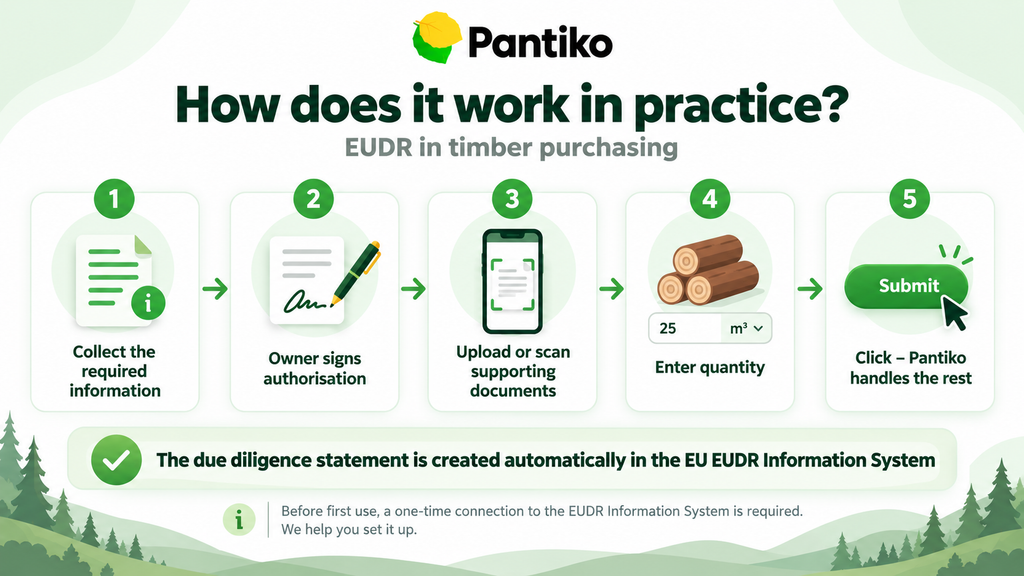
In Pantiko, the workflow can be very simple:
- Collect the required information or documents from the forest owner.
- Give the owner the authorisation to sign.
- Upload the supporting information.
- Where the relevant documents and format are supported, they can also be scanned and used to speed up data entry.
- Enter the timber quantity and the remaining transaction information.Create the statement.
From there, Pantiko handles the EUDR process and the due diligence statement is created in the EU EUDR Information System automatically.
Before using this workflow for the first time, a one-time setup and connection to the EUDR Information System is required. We help our customers complete that setup.
EUDR should be part of timber purchasing, not a separate administrative system
This is the main idea behind how EUDR works in Pantiko.
Pantiko is not simply an EUDR submission tool.
You already need to manage suppliers, timber purchases, quantities, documents and traceability. EUDR is another layer of information connected to that same timber.
Instead of entering the same data in several places, keeping references in spreadsheets or trying to work out months later which DDS belongs to which purchase, the EUDR information remains connected to the underlying transaction.
You manage the timber purchase. Pantiko takes care of the EUDR process alongside it.
For companies purchasing from many private forest owners, this is particularly useful. Suppliers do not all need to develop their own EUDR workflow before they can sell timber to you. You can offer them a consistent process as part of the way you already purchase timber.
Want to offer this to your suppliers?
If you buy timber directly from forest owners, we can show you how to include EUDR in your existing purchasing workflow.
We will also help you with the initial connection to the EU EUDR Information System. After that, DDS submissions can be prepared directly through Pantiko as part of your normal work with suppliers and timber purchases.
Contact us at contact@pantiko.com or sign up below to see how the process can work for your suppliers.